Philips HeartStart HS1 vs FRx: Which AED Should You Buy?
July 18, 2026 2026-07-20 10:28Philips HeartStart HS1 vs FRx: Which AED Should You Buy?
 admin
admin Philips HeartStart HS1 vs FRx: Which AED Should You Buy?
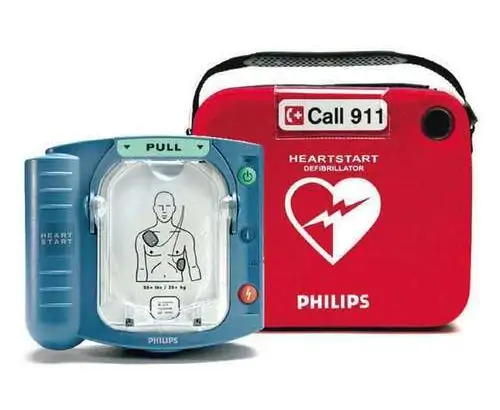
Philips HeartStart HS1 vs FRx is the comparison most buyers face when choosing an AED for a home, office, school, or public space, since both are genuinely reliable, voice-guided defibrillators from the same manufacturer.
Here’s how they actually differ, so you can pick based on where the device will live and who might need to use it.
Philips HeartStart HS1 vs FRx — Side-by-Side
| Specification | HeartStart HS1 | HeartStart FRx |
|---|---|---|
| Price | ₹99,000 | ₹115,000 |
| Best Environment | Home, office, indoor public spaces | Rugged/outdoor — withstands drops, dust, water |
| Durability Rating | Standard indoor use | Withstands 500 kg crush, 1.2m drops, IPX5 dust/water |
| Shock Delivery | Quick Shock, ~8 sec after CPR | Quick Shock, ~8 sec after CPR |
| Pediatric Use | Yes, with Infant/Child SMART Pads Cartridge | Yes, with optional Infant/Child key |
| Battery Life | Multi-year, self-tested daily/weekly/monthly | Up to 4 years between replacements |
| Configuration | Ready-Pack — pads and battery pre-installed | Pre-connected SMART Pads II, carrying case included |
Who Should Choose the HeartStart HS1
The HS1 is built for indoor environments — homes, offices, schools, and community centers — where the device sits in a stable, climate-controlled location. Its Ready-Pack configuration means it’s genuinely ready to use the moment it’s unboxed, with pads and battery already installed.
Who Should Choose the HeartStart FRx
The FRx is the rugged option, built to withstand rough handling, extreme temperatures, dust, and water exposure. It’s the better choice for workplaces like construction sites, warehouses, factories, or vehicles where the AED might face harsher physical conditions than a typical office.
Philips HeartStart HS1 vs FRx — Quick Decision Summary
If you’re still weighing Philips HeartStart HS1 vs FRx for your specific space, here’s the simplest way to decide: choose the HS1 if the device will sit in a climate-controlled indoor location like an office reception, school nurse’s room, or home.
Choose the FRx if it needs to survive rougher conditions — a warehouse floor, a vehicle, a construction site, or anywhere dust and temperature swings are a real factor.
Both units deliver the same core life-saving capability — voice-guided, layperson-ready shock delivery in roughly 8 seconds after CPR — so the Philips HeartStart HS1 vs FRx decision really comes down to environment and durability needs, not a difference in clinical effectiveness.
Philips HeartStart HS1 AED Defibrillator — ₹99,000
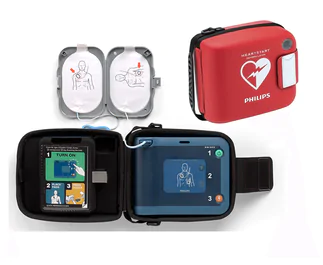
Philips HeartStart FRx AED Defibrillator — ₹115,000
Essential Accessories to Budget For
An AED isn’t a one-time purchase — pads and batteries have expiration dates and need periodic replacement to keep the device ready for an actual emergency. Check with our team for current pad cartridge and battery availability for your specific model.
- AED Box (Cabinet) Compatible For Philips — ₹9,999 (wall-mounted protective housing, recommended for public/workplace installations)
Why Having an AED Matters
Sudden cardiac arrest requires defibrillation within minutes to meaningfully improve survival odds, and both the HS1 and FRx are designed for use by laypeople with no medical training — voice prompts guide the responder through every step.
The World Health Organization’s data on cardiovascular disease underscores why rapid access to a defibrillator in workplaces and public spaces is increasingly treated as a baseline safety measure, not an optional extra.
Keeping Your AED Ready
Both the HS1 and FRx run automatic self-checks — daily, weekly, and monthly — to confirm the device is ready to fire if needed. These checks cover battery charge, pad connectivity, and internal electronics, and the unit will visibly indicate if something needs attention.
Beyond the automated checks, plan for periodic manual replacement of pads and batteries before their expiration dates.
Consider a wall-mounted AED cabinet if the unit will be installed in a public or shared space — this protects the device and makes it instantly visible to anyone responding to an emergency.
Not sure which AED fits your space? WhatsApp our team and we’ll help you choose between the HS1 and FRx based on where it’ll be installed.
Frequently Asked Question
Do I need training or a prescription to buy an AED?
No — AEDs are designed for use by anyone regardless of medical training, and no prescription is required to purchase one for home, office, or public use in India.
How often do AED pads and batteries need replacing?
Pads and batteries have expiration dates, typically requiring replacement every few years depending on the model and usage — the HS1 and FRx both run automatic self-tests to alert you when replacement is due.
Which AED is better for a school or office — HS1 or FRx?
For a climate-controlled indoor space like a school or office, the HS1’s Ready-Pack configuration is a straightforward, reliable choice. The FRx is worth the extra cost mainly if the device may face rougher handling, dust, or moisture exposure.